Sunday, 15 July 2018

Visual Text Analysis Assignment about Visual Elements, PACC & Message : Dhruv (10)


In red:BUT MARINE ANIMALS AND BIRDS DO

In white (under red):100,000 MARINE BIRDS AND ANIMALS ARE KILLED EVERY YEAR FROM PLASTIC WASTE

Textual: The text uses words like "DOESN'T"
to show the message boldly
Visual: The pictures show the things talked about in this poster.
Typography: The title is large and in perfect with the background to catch people's attention.
Layout: The main message is the largest to show importance and then the information and details
Purpose: Is to try to encourage people that plastic can heavily harm marine animals and birds.
Audience: General Public
Context: People often overuse plastic.
Culture: People in Singapore generally do truly understand how deadly plastic can be.

Message: This poster is trying to encourage people to use less water.

Visual Text Analysis Assignment about Visual Elements, PACC & Message By Ivan

Visual: The posters shows food being thrown away, with money in the forms of coins being thrown away too. I think what the poster is trying to convey visually is that when we waste and throw away food, it is equivalent to wasting and throwing away money.

Textual: The text "When we buy, order or cook too much food, we waste our hard-earned money." shows that the food we waste is equivalent to wasting money. The poster also gives us factual information on how much food we waste like "On average we generate 2 bowls of food waste a day." and "786 million kilograms of food waste was generated in Singapore in 2015." to show to the reader the severity of the amount of food we waste, so they will be willing to change and stop food waste. 

Typography:  The text "Waste less. Save more." is enlarged and has a big contrast against the background to catch the readers attention from far, so they will go on to read more. The number "786 million kg" is enlarged to catch the readers attention so they will notice the severity of the amount of food we waste.

Layout: The heading of this poster is placed on the top of the poster as people usually read from the top down. The pile of food waste is placed in the centre of the poster to create emphasis on food wastage. Other information is neatly placed around the poster to make it easy to read.

Message: The message is that we need to stop buying more than we can eat, as that will generate food waste, and the food we waste is equivalent to the money we waste. 

Purpose: To inform the readers about the large amount of food we waste, and to persuade the reader to waste less food.

Audience: General public.

Context: Singaporeans are buying more than they can eat, therefore they waste food. This food they waste is equivalent to the amount of money they waste buying the food.

Culture: People think that it is alright to waste food as it does not impact themselves.


Visual Text Analysis - Sylvester Koh (24)


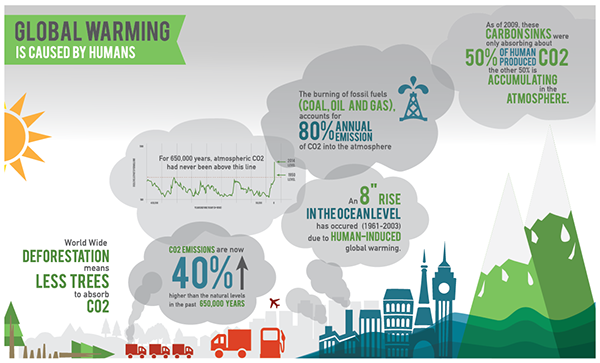
Visual: The data is presented in bad gases like carbon dioxide, and in dark colours to show that the environment has been getting from bad to worse. The harmful gases are from cities and forests and factories to show that these are the main contributions to the adverse change to the environment.

Textual: Terms relating to Earth, like "ocean", "atmosphere" used to show that what the humans have been doing really makes a significant impact to the environment. Also, the term "CO2" which stands for carbon dioxide is used to show that the amount of harmful gas we have been releasing is really impacting the environment, to make things worse, deforestation which means "less trees to absorb CO2" as mentioned in the text.

Typography: Keywords in the "bad gases" such as the causes of the adverse change and the change in statistics like percentage increase are larger to show the drastic changes and what we have been doing that made a significant impact in our environment. 

Layout: The main statistics are presented like clouds and are placed in the sky. Some of the words that are key are enlarged. 

Purpose: To inform people of the drastic changes in the environment, and trying to persuade them to make the change so that the environment may be improved.

Audience: General Public

Context: The amount of Carbon Dioxide has been increasing lately which contributes to Global Warming. A key reason is that of human activities like the burning of fossil fuels for electricity. Therefore, through designing this visual text, the creator hopes to advocate on this issue and persuade them to take action on the issue.

Culture: Many people think that the environment wouldn't turn that bad so these people don't take action regardless.

Message: The poster is to encourage people to take action on the recent changes in the environment.

Saturday, 14 July 2018

Visual Text Analysis Assignment about Visual Elements, PACC & Message : Dayna (4)


Visual: The tree in the middle is missing half of its leaves and about half of the tree is dried to show that the poster has something about the depleting number of trees on the earth. The tree can also be depicted as the trees are dying or how incomplete the earth will be without trees. 

Textual: The text "Don't cut the cure" tells us that when we cut trees, we may be cutting a tree that can be used as a cure for illnesses or cancer. The text "Plant one" is capitalised and have a different font colour to catch the viewer's attention and urges all to help and plant trees instead of cutting them down, a command. The text below the tree asks people to donate to the organization to save the trees as they might have the cure for illnesses and the statistics show that the forests are dying out and needs everyone's help to stop that from happening. The text below the heading explains the importance of the forests and how they can help for medical discoveries and backs up this claim by saying "Currently,121 prescription drugs sold worldwide come from plant-derived sources." , which are found in forests.

Typography: The headings are all capitalised and big to catch the reader's attention and inform readers of the content of the poster. The test "Plant one" is the biggest to tell people there is a solution to this problem and makes it clear so that people can try to play their part for this cause.

Layout: The tree is placed right in the middle of a white background to create emphasis on the tree to catch people's attention. The headings are placed at the top as people usually read from top to bottom. The rest of the text is placed in neat boxes in alignment to make the poster look neat and easy to read.

Purpose: To raise awareness about the importance of forests and that we must stop deforestation which may contain the cure for cancer and illnesses which everyone wants so that their loved ones will be able to be cured should they be suffering from any illness.

Audience: The general public, people who use products that require trees to be cut down and encourage them to reduce their usage to reduce deforestation.

Context: The number of forests is depleting and we need to stop deforestation and plant back the trees being cut down as those forests may contain the cure for illnesses which may save many lives.

Culture: People may only think deforestation only affects the environment but this poster shows that deforestations also have other effects like cutting down the trees may remove the cure for people for are suffering from a certain illness. If the cure can be found in these forests, many lives can be saved.

Message: Deforestation may stop us from discovering a cure for illnesses which can save many lives. We must save these forests and stop deforestation. We should also plant back these trees instead of cutting more of them down.

Visual Text Analysis Assignment about Visual Elements, PACC & Message, by: Florence (5)

Visual: The words of negativity are put together to form a human head. I think that the visual is trying to convey that stress can really affect you negatively through both mentally and physically.

Textual: The poster uses words such as “worry”, “agitation”, “alone” and etc. These words show the readers how a person feels when they are stressed out. It also has the word “serious” which it wants to emphasise to the reader that this is an important issue and it should not be ignored by anyone as it can lead to unfavourable sequences.

Typography: The main problem is being represented in a red font which makes it stand out from the black background with white words to emphasise the importance of it. Moreover, it is also being bolded and has a bigger font size to attract the reader's’ attention easier. On the other hand, the feelings and consequences are represented in a smaller font and a less standing out colour in contrast to the background to form a harmonious feel when someone read it.   

Layout: The main word is being placed right in the centre to attract the reader’s attention. The arrangement allows the reader to spot the main message and start to read from top to bottom. Besides that, it also various font sizes to guide the reader which of the texts come first for the convenience of reading.

Message: The message that is being conveyed is that one should care for their mental health more and manage their stress better to prevent a negative impact on themselves.

Purpose: The purpose of the poster is trying to persuade people who are facing stress to voice out and not bottling up on their own. 

Audience: The audiences are people who are facing challenges and going through a harsh phase in their life, causing them to feel uneasy and stressed out.

Context: Some people are just bottling up, hence, causing them the overwhelming flurry of emotions that can lead to undesirable actions.

Culture: The beliefs are that readers of the poster should reach out to those who are going through this episode and give them pieces of advice. However, those who are going through this themselves believe that it is not a big issue. 


Visual Text Analysis Assignment about Visual Elements, PACC & Message. By Jessen

Textual: The text uses words like "Let's" and "every"
to show the importance and significance of what we have to do.
Visual: The pictures clearly show how we can save water in our daily lives.
Typography: The title and the sub heading are blue in colour to show the relation to saving water and they are also larger to catch people's attention.
Layout: The pictures are all evenly spaced to show that all these actions to save water are important and there is no particular one that stands out.

Purpose: Is to try to encourage people that they can save water in their daily lives.
Audience: General Public
Context: People often waste water by not using the such way as listed above.
Culture: People in Singapore generally do not think that Saving water is necessary.

Message: This poster is trying to encourage people to use these methods to save water.

Group 1 Badge Night Speech Podcast

URL to our group's podcast : https://drive.google.com/open?id=1qTCq7IAsqfEZMeuiHAG0cmXABQNWzBNT

Wednesday, 2 May 2018

LA Common Test

2018 Secondary 1
Language Arts Common Test

INSTRUCTIONS

No correction tape or fluid is allowed.
Attempt all questions in dark blue or black ink only. 
Writing paper will be provided.

PAPER 1Date            :     4 May 2018, Friday
Duration      :     1 hour 50 minutes
Time           :      0750-0940          
Score          :     60 marks

Section A: Situational Writing [30 marks]
Candidates write a text of 250–300 words based on a given situation which will involve viewing a visual text. Candidates are required to write the text (an informal email) to suit the purpose, audience and context.

Section B: Continuous Writing [30 marks]
Candidates choose one out of four topics (two with a visual stimulus) to write a text of 250–350 words in continuous prose. The topics set may cover different types of narrative texts (e.g. a story, a personal recount or reflective writing).

PAPER 2Date            :     4 May 2018, Friday
Duration      :     1 hour 50 minutes
Time           :      1040- 1230       
Score          :     50 marks 

Section A only [50 marks]
This section contains a text, which is narrative in nature, based on which candidates are to answer questions testing comprehension, vocabulary in context, the use of language for impact, summary writing and reader’s response.